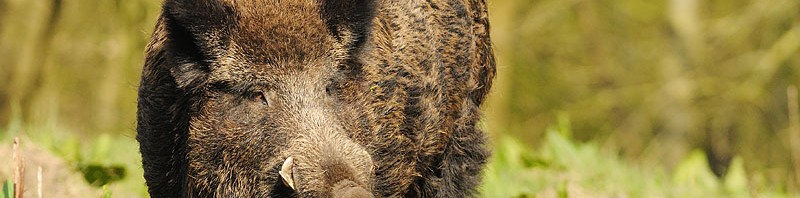

How to Stalk, Kill, and Cook a California Wild Pig
I decided that unless I become a vegetarian, I’ll get my meat by hunting for it. … I’ve seen slaughterhouses, and anyway, as Sitting Bull said, when the buffalo are gone we will hunt mice, for we are hunters and we want our freedom.
—Thomas McGuane
For years, Northern California and the Bay Area have proudly flown the flag of epicurean hedonism, leading the nation in wine production and nouveau cuisine. Even in this merlot-soaked, fresh-organic-ingredients milieu, where great chefs are treated like celebrities, it is seldom noted that the region boasts another little-known gastronomic piece de resistance—the feral pig.
According to the California Department of Fish and Game, wild pigs (Sus scrofa) are a nonnative species. Our wild pigs are, in fact, one of the happier accidents of animal husbandry. Settlers introduced domestic swine to California in the 1700s, some of which wandered into the wild. Then, in the 1920s, a landowner imported the European wild boar to Monterey County. The boars mated with the local feral pig population, creating a wild boar/feral domestic hybrid. Today, at least 45 California counties are up to the elbows in Sus scrofa. These wild pigs are covered in hair, have tusks, and multiply very quickly. One of their few natural predators is the mountain lion. Another is the human being.
Last year, California hunters bagged approximately 30,000 wild pigs, with the heaviest concentrations being found in Sonoma, Mendocino, and Monterey counties. Unlike other game animals, pigs come with almost no restrictions. You can hunt them every day of the year, with no daily limit. You can use any size bow and arrow, rifle, or pistol. And hunting a wild pig is dirt cheap—five pigs will cost only $7.90 in Fish and Game tags. Some say it’s the best bargain in the state—of any kind. Whether that claim is fact or exaggeration, California’s wild boars attract hunters from all over the world.
Many big-game hunters place importance on bagging a trophy for the wall of the den or the rug on the floor. Pig hunters are a different, oddly self-actualized breed. They hunt wild boars because they eat them. The meat is delicious and free of preservatives or hormones.
This article will show you exactly how to stalk, take, prepare, and dine upon your own wild pig. To help compile this guide, SF Weekly retained the services of two Bay Area swinologists, who requested that their identities be concealed for fear of retaliation by Northern California’s large population of animal rights activists. For purposes of identification, we’ll call our pig consultants the Philosopher and the Pragmatist.
The Philosopher runs his own South of Market business; the Pragmatist is a successful practitioner of the culinary arts. They have hunted pigs together for five years, averaging five or six expeditions per year. In exchange for anonymity, the two agreed to share their boar-hunting expertise—including a tour of a secret pig-heavy location in rural Sonoma County.
I. What You Need
A logical first step in hunting pigs is to obtain a copy of the Fish and Game Department’s Hunting Guide for Wild Pigs in California, which covers the basics and includes maps of public hunting areas. You will also need a state hunting license, which costs $27.55 for adult residents, and a tag for each pig you take ($7.90 for five).
If you have never gone before, it’s advisable to bring along somebody familiar with wild boar hunting. Ask the Central Coast Fish and Game office in Napa for a list of local pig outfitters. These guides typically take people on one- or two-day expeditions. On these excursions, most supplies are included, but fees can exceed $500 for a weekend. If you don’t use an outfitter, your bare minimum of supplies should include binoculars, knives, a knife sharpener, plenty of rope, rubber gloves, a strong hacksaw, a bucket, and a source of fresh water.
In California, pig hunting is allowed on any public land managed by federal, state, or local government agencies, with minor restrictions. Experts, however, say these areas have been hunted so frequently that the pigs have learned to avoid them. Results are best on private land, where hunters strike deals with landowners for access to pig-friendly property. Hunting is most successful during early spring or early fall, when seasons are changing, but people have good luck just about any month of the year. The ideal time is either dawn or dusk, when the pigs feed.
(Despite the small cost and few restrictions—the only significant regulation on boar hunting requires that they be taken during daylight hours—some people still find it necessary to poach wild pigs. Poachers often use dogs to bring down the pig, then finish it off with a knife. As protection against the pigs’ sharp tusks, the dogs are dressed in suits of armor. This technique, supposedly, is less noisy than shooting. Fish and Game staff regularly patrol the twilight pastures with infrared equipment, and sometimes set up pig decoys to draw out illicit hunters.)
As far as weaponry goes, both the Pragmatist and the Philosopher swear by the Remington .308 rifle with scope, but almost any caliber gun will do. If you’re really serious about pig hunting, the bow and arrow apparently is the ultimate way to go. But remember: Creeping within 30 yards of a wild pig requires camouflage, and silent clothing. And a healthy reserve of courage.
II. The Hunt
Pig hunters speak of their craft as having two basic methods. The first—“spot and stalkâ€â€”means that you walk through the countryside until you see a pig, then stalk it until you’re close enough for a good shot. The second method—“fair chaseâ€â€”involves a pack of dogs, whose presence can turn a hunt into a complicated, noisy circus.
Outfitters often bring dogs, one hunter says, because it gives the impression of a real safari, an atmosphere that allows them to charge novice hunters more money. Unfortunately, dogs also will chase the pigs up and down the hills. According to John Waithman, author of the Hunting Guide for Wild Pigs in California, running builds up lactic acid in the muscles, which can diminish the flavor of the meat and make it tough. The true wild boar aficionado, therefore, hunts alone or with one other person. No guides. No dogs. Our expedition will be of the dogless spot and stalk variety.
Once you reach a hunting location, park your vehicle and bring weapons only. Leave most everything else—the binoculars, knives, rubber gloves, hacksaw, and bucket—for later. Walk quietly but quickly through the gray dawn, scanning the fields and inspecting the trees. Once the sun comes up, you won’t have much time. Keep an eye out for footprints and boar scat. Matted grass is a sure sign that a herd has bedded there during the night. Stop and listen frequently. If pigs have been feeding in the area, the grass will be turned over in clumps where they have rooted for food. (This so-called “depredation†can very quickly render a field useless for any agriculture; some farmers become pig hunters simply to protect their crops.)
The Sonoma County scenery in which our hunt takes place is magnificent. Across one fence is a flower farm; over the next hill is a winery. But don’t let idyllic surroundings lull you into thinking you’re enjoying a pleasant, if well-armed, early morning stroll. Remember: You’re not hunting cute pink pigs from the county fair. These are hairy, muscular wild boars. They are fast and smart, stand 30 inches tall at the shoulder, measure 4 to 5 feet in length, and can weigh up to 300 pounds. The hide over their shoulders serves as a thick armor plating, and their tusks grow to be 3 inches long. Their eyesight is poor, but their sense of smell is excellent. Stay downwind if at all possible.
The Pragmatist says the secret of pig hunting reflects most of life’s difficult quests: Be at the right place at the right time. Gesturing to a patch of trees, he whispers, “They like to be under the oaks. I shot a beautiful sow right over there.â€
But if wild boars are plentiful in Northern California, finding a herd is never guaranteed. You may walk the length of a pasture, stumbling over uprooted grass and other signs of pig infestation, and not see any pigs at all. Furthermore, pigs are difficult to track, because they don’t migrate single file, as do other animals. Boars travel in herds, wriggling through barbed wire fences, and they cover up to 40 square miles a day. Even if you come across signs of pigs, they may have already moved onto the next ranch.
But you may get lucky. One of your party—perhaps, say, a panting journalist with a notepad—may spot a straggler, standing under some trees, feeding. Snout to the ground, tail twitching back and forth, this lone pig may be your only chance. Once the herd hears the first shot, wherever they are, they’ll be moving like hell.
III. The Kill
“Nobody who loves to hunt feels absolutely hunky-dory when the quarry goes down,†novelist Thomas McGuane wrote in 1977 in Outside magazine. “The remorse spins out almost before anything, and the balancing act ends on one declination or another.â€
Any honest hunter will agree. Animals are living things, and a successful hunt ends when you take a life. As soon as the Pragmatist shoulders his Remington and drops the pig, it’s no more fun and games. The dying squeals of a pig thrashing in the grass are really creepy, especially when they are echoing across the dewy golden hills of Sonoma County. The spectacle makes most first-time observers shiver; for a moment, you may consider moving to the coast of Oregon, living in a yurt, and eating nothing but wild onions. (Even the Pragmatist and the Philosopher acknowledge the death noises are an unfortunate part of the hunt.)
Ideally, when shooting a pig, you should aim for the shoulder, which will send your bullet into vital organs and yield a quick kill. If you hit another part of the animal, such as the back, you must pursue the pig and try to bring it down as quickly as possible. Keep in mind, however, that if a wild boar is wounded, it will often turn and charge. Always approach a downed animal slowly, keeping a pistol or knife within easy reach. (Or, as state feral pig expert Waithman puts it: “This is where the fun comes in. They can be very aggressive. Those tusks are as sharp as can be.†And he is not exaggerating; the Pragmatist has been gored by a wounded boar.)
Once your pig is dead, you should stand over the kill, assessing its age and weight (in this case, it’s a young boar, 140 pounds) and determining the location of the fatal wound (the stomach, i.e., a “gut shotâ€). Then signal the rest of your party with a whistle. They will have heard the squeals, but won’t know your precise location.
IV. The Field Dress
Once you’ve completed the post-kill inspection, relocate the pig and prepare it for field dressing. For transporting boar, the Pragmatist carries a rope in his back pocket. It is several feet long and has a wooden handle knotted into it. Wrap the rope around the pig’s hind feet, and it’s ready for transit. The Pragmatist hauls the pig a few hundred yards down a long grassy slope, and stops at a moss-covered tree with good-sized branches. A single pig foot lies in the shade nearby. He toes it with a boot; he’s used this tree before.
Dressing a pig starts with the use of a device called a “triple tree,†a metal frame with rope that will be used to hang the pig. Attach the hind legs to the two prongs of the triple tree; then, with the assistance of a friend, throw the rope over a branch and hoist the dead pig off the ground.
Put on rubber surgical gloves, grab a knife, and make initial incisions down the belly, starting between the hind legs, being careful not to puncture the bladder. As you slit the length of the pig’s abdomen, you should silently hope that the pig was a male and not a sow. Another unfortunate aspect of hunting pigs: If you bring down a mother pig, among all the entrails, you may find unborn piglets.
“There’s no babies,†observes the Philosopher. “That’s good.â€
Now, using both hands, you should rummage around in the central body cavity, severing major organs and viscera from connective tissue, and then pull the pig’s innards out of the abdominal cavity all at once, so they splat to the ground intact.
Find the liver, a delicacy in and of itself, and if it’s not soiled with urine, feces, or undigested food, stash it in a separate plastic bag. Gently trim out the bladder and genitals, and toss them far away. Begin on the head. The pig was most likely feeding, so the esophagus will be full.
If you encounter trouble in removing the head with the hacksaw, finish the task with a sharp knife.
The Pragmatist holds up the head and asks, “Any interest?â€
Nobody answers, so he heaves it aside. It rolls down a slope and stops, its death gaze fixed on the horizon.
“Coyote will clean it up tonight,†says the Philosopher. “Turkey vultures. It’ll be gone by morning.â€
(The heads of most wild pigs don’t seem large enough to warrant display, but the Philosopher remembers visiting an archery shop in Santa Cruz and seeing an impressive head on the wall—from a 700-pound boar.)
Begin removing the hide with a knife, starting at the top with the hind hooves. Cut and peel as you go, working in vertical strips, taking care not to carve too deeply into the muscle. Trim out any tissue near the wound. Rinse the carcass inside and out with a bucket of water. Lower it onto a plastic tarp, then remove the front and hind feet with the saw.
Wrap the carcass up in the tarp. This dressed pig weighs about 50 pounds, yet is compact enough to fit into the trunk of a mid-’80s Camaro.
Fill out the required state Fish and Game pig tag, noting your name and license number. Tear off one portion and mail it to the state. Keep the other part of the tag with your carcass, in case you are stopped and asked for documentation. Go have breakfast in a Sonoma County town, at a restaurant surrounded by antique stores. The clock on the wall should read roughly 7:30 a.m.
V. The Meal
Describing the rewards of the hunt often leads one into cliche. There is a reason for this—the ritual of dragging an animal home to the village is timeless. Both the Philosopher and the Pragmatist emphasize the importance of using the pig for food. That’s why they hunt.
“Humans … care more about a dog than real people,†explains the Philosopher. “You’re desensitized to where things come from. Your sensibilities are gone if you don’t do these kinds of things. They’re dormant inside us. It’s the roots of civilization.â€
Any moment of hesitation to use the carcass to throw a pig dinner party is, therefore, met with puzzled looks. Bringing meat home to your friends is the finale of the primal process.
The pig you have taken should either be cooked within five days (spit-roasting is highly recommended) or cut up and frozen. Whether you plan to cook or freeze it, try to stretch out the body before rigor mortis sets in. Otherwise the carcass will stiffen, and you’ll be stuck cooking it in whichever permanent shape it has assumed—for instance, the bottom half of your refrigerator.
Recipe suggestions are available from the Fish and Game’s pig manual. You might also check out the University Press of Virginia book Unmentionable Cuisine, a collection of offbeat animal recipes written by Calvin W. Schwabe. One classic method of preparing wild boar originates in Hawaii, where the pig is wrapped in banana leaves and buried in a pit of lava stones. Unfortunately, this luau method is extremely time consuming, and may begin with the words, “Wake up at 3 a.m. and begin lining the pit with rocks.â€
The Pragmatist provides a tasty yet simple roasting alternative: “Wild fennel, hot pepper flakes, salt, pepper, and garlic. That’s all you need.â€
Once you decide to cook your boar, quickly alert a team of gastronomes who are willing to eat a hog on short notice. Drive across the Bay Bridge and rent an electric spit rotisserie from Big 4 Rentals in Berkeley (the San Francisco Big 4 location doesn’t carry this item). Expect a guy at the loading dock to caution you to occasionally spray the pig with water, because if the fat pockets catch on fire, “your pig is gone.â€
Pick up 6-inch pieces of oak and a bag of mesquite. Salt the carcass, cut slits, and embed garlic cloves into the flesh. Impale the pig on the rotisserie skewer, using chicken wire to securely lash the legs so they won’t flop around or fall off. Spread pepper over the surface, and start the spit.
Anticipate cooking the hog from four to six hours, depending on size. Keep the fire hot, adding briquettes to keep up the temperature. Plan to cook the meat to 170 degrees Fahrenheit, minimum, which will kill stray parasites and microbes that cause diseases such as trichinosis and brucellosis.
Take a basting mixture of olive oil, red pepper flakes, and ground black pepper and coat the entire pig as it rotates, using a basting brush. (A brand-new unused paintbrush will also work.) Note that as the carcass turns, the first areas to change color will be the wounds.
Watch the expressions on the faces of your dinner guests when they first see the beast, turning on the spit, atop a roaring blaze. Refreshments can range from oxblood wine coolers to Henry Weinhard’s Wild Boar Pale Ale. The most appropriate pig-dining music: 16th-century harpsichord (released on Wild Boar Records), or ‘70s riff rock from big-game hunter/guitarist Ted Nugent.
Near the end of the process, soak the mesquite chunks in water, then drain and sprinkle over the hottest portions of the fire. This will give off maximum smoke to further flavor the pig. After the fourth hour of cooking, your guests will signal their growing hunger by either staring silently into the flames, or offering an endless stream of contradictory cooking suggestions.
When the pig appears done, connoisseurs will swarm around the rotisserie like Neanderthals, plucking pieces as they carve. Many will tear off pieces of meat while it’s still turning on the spit. Cutlery will not be necessary. Serve up a side dish or two, but don’t offer too many alternatives. Keep the focus on eating flesh.
As guests feed, an odd silence will wash over the spectacle, interrupted only by an occasional mewl or groan. The taste is exactly as it’s been described—lean, clean, and fresh. The best cut will be the loin, the portion of the pig’s back between the rear leg shoulders.
Any meat that looks pink or rare will be from an interior portion of the beast; this underdone flesh should either be cooked fully on a barbecue grill, or frozen for later use.
Hunting, killing, dressing, and cooking a wild pig may seem crude to San Franciscans who have adopted an every-organism-is-sovereign lifestyle. But a certain barbaric poetry emerges from the ritual of slaying a beast and feeding it to friends. Even in a city back yard, it’s possible to reclaim one’s inner carnivore, and reconnect with earthy origins. On another, more practical note: If you spit-roast a wild pig in San Francisco, you can be sure your guests will discuss the event for days; the event might even warrant mention in the news media.